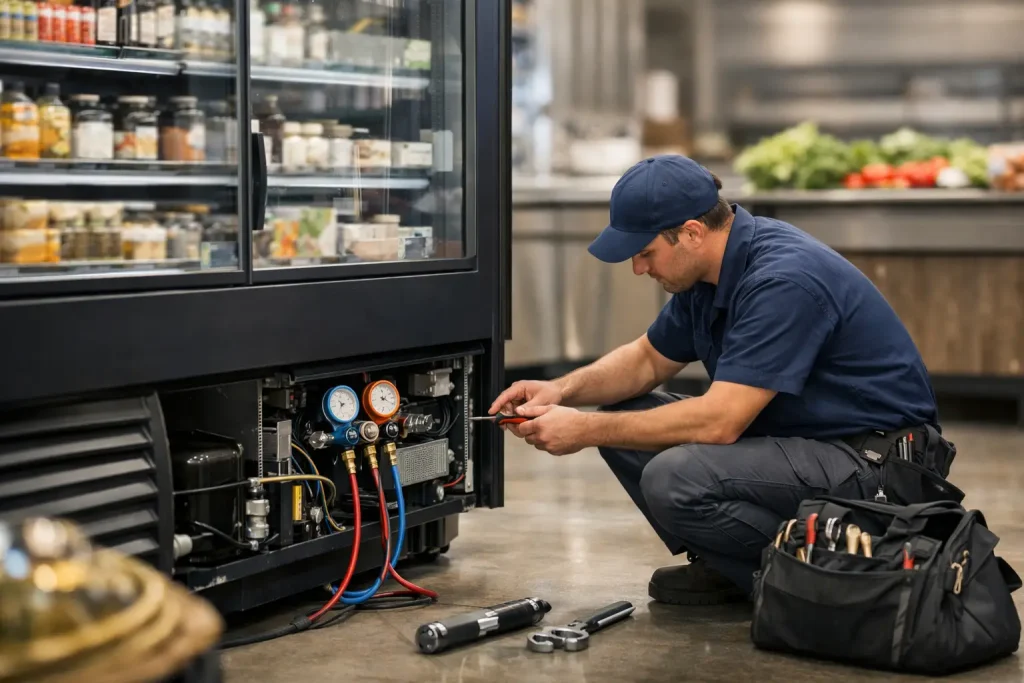
When a cold room climbs a few degrees during service, or a display fridge starts short cycling in the middle of trading, the problem is rarely just temperature. It is stock at risk, staff under pressure, customer service slipping and compliance questions arriving fast. That is why commercial refrigeration repair needs to be quick, accurate and handled by engineers who understand how a fault affects the whole site, not just the unit.
For restaurants, retailers, hospitality venues and managed buildings, refrigeration failures do not happen at a convenient time. They appear during peak service, overnight, before deliveries or just as ambient temperatures rise. A slow response can mean spoilage, emergency stock moves, lost revenue and unnecessary disruption. A proper repair service is not simply about replacing a part. It is about restoring stable operation with minimal downtime and making sure the same issue does not return a week later.
What commercial refrigeration repair should actually cover
Good repair work starts with fault finding, not guesswork. Commercial systems are rarely simple plug-in units with one obvious failure point. They may include integral cabinets, cellar cooling, walk-in cold rooms, freezer rooms, remote condensers, controllers, evaporators and associated ventilation or drainage issues. The visible symptom might be warm product, ice build-up, alarms or unusual noise, but the root cause can sit elsewhere in the system.
A reliable engineer will look at the full operating picture. That includes refrigerant pressures, air flow, coil condition, compressor performance, fan motors, expansion components, defrost operation, electrical supply, sensors and control settings. If the site has multiple units, the wider load on the system matters too. One recurring problem in commercial environments is treating the symptom quickly just to get through the day, while the underlying fault remains unresolved.
That is where experience counts. In live commercial environments, repair decisions often involve trade-offs. You may need a temporary fix to hold temperature and protect stock, followed by a planned return visit for a permanent repair outside trading hours. In other cases, immediate component replacement is the only sensible route because continued operation risks compressor damage or food safety failure. The right approach depends on the age of the plant, criticality of the cooling and how quickly parts can be sourced.
Common faults in commercial refrigeration repair
Temperature instability is one of the most common triggers for a callout, but it does not point to one single issue. Dirty condensers, failed evaporator fans, blocked drains, sensor faults, refrigerant leaks and poor door seals can all affect case temperature. So can poor loading practices and warm air ingress in busy kitchens or retail settings.
Short cycling is another frequent complaint. A unit that starts and stops repeatedly may be dealing with dirty coils, incorrect refrigerant charge, a failing control, poor ventilation around the condenser or a compressor beginning to struggle under load. Left alone, short cycling increases wear, pushes energy use up and often turns a manageable repair into a more expensive breakdown.
Ice build-up deserves proper attention as well. Frost on evaporators or internal panels can result from failed defrost heaters, faulty timers, sensor issues, damaged gaskets or prolonged door opening. The temptation is to defrost and restart, but unless the cause is identified, the problem usually returns quickly.
Electrical faults also play a bigger role than many operators expect. Contactors, relays, control boards, probes and wiring faults can mimic mechanical failures. That is why refrigeration repair should sit with engineers who are comfortable across both the refrigeration circuit and the electrical control side of the system.
Why speed matters, but diagnosis matters more
Urgent response is essential in refrigeration. If chilled or frozen stock is involved, every hour matters. But there is a difference between turning up quickly and solving the problem properly. Businesses need both.
Fast attendance reduces immediate risk. It allows stock management decisions to be made early, helps teams maintain service and lowers the chance of a complete shutdown. Yet the value of that fast response drops sharply if the engineer arrives, resets an alarm and leaves without identifying why the alarm occurred.
The best commercial refrigeration repair combines rapid callout capability with methodical fault diagnosis. That means arriving prepared, communicating clearly with the site team and working through the likely causes in a structured way. It also means being honest. If a unit is approaching the point where repeated repairs no longer make financial sense, the client should be told plainly.
For facilities managers and business owners, that honesty matters. No one wants to pay for repeated emergency visits on ageing equipment if the money would be better spent on a targeted upgrade or replacement. Equally, not every old unit needs replacing immediately. Sometimes a sound repair and a maintenance plan will give dependable service for years. It depends on condition, efficiency, refrigerant type, parts availability and how critical the application is.
Commercial refrigeration repair and compliance risk
In food-led environments, refrigeration faults carry a compliance dimension as well as an operational one. If product temperatures move outside acceptable ranges, the issue can affect food safety records, stock viability and inspection outcomes. In pharmaceutical, laboratory or specialist storage settings, the consequences can be even more serious.
That is why repair work should not be treated as a simple reactive trade service. It needs to support temperature control, documentation and confidence in the system once it is back online. A proper repair should restore performance, but it should also leave the customer with a clear understanding of what failed, what was done and whether further work is recommended.
If leak detection, refrigerant handling or energy performance concerns are involved, technical competence becomes even more important. Commercial clients do not just need an engineer who can get a unit running. They need one who understands system integrity, long-term reliability and the standards expected on a professional site.
When repair is the right choice and when it is not
Not every breakdown leads to replacement, and not every repair is good value. The right decision depends on context.
If the unit is relatively modern, the fault is isolated and the rest of the system is in good order, repair is usually the practical route. A fan motor failure, sensor issue, drain blockage or control fault can often be resolved cost-effectively if caught early. The same applies to many component failures where the plant is otherwise sound.
If the system has a history of repeated callouts, poor temperature recovery, high running costs or obsolete parts, the picture changes. Repair may still be needed to restore short-term operation, but it should be weighed against replacement or retrofit planning. Older systems can become expensive not because each individual fault is huge, but because downtime, labour, energy waste and repeat attendance add up.
This is where a service-led engineering approach makes a difference. Rather than treating each breakdown in isolation, the repair should feed into a wider recommendation. That might mean improved maintenance intervals, airflow improvements, controls upgrades or a phased replacement plan that avoids another emergency later.
How to reduce emergency callouts after a repair
The best repair is the one that stabilises the system and lowers the chance of another urgent failure. In commercial settings, that usually means looking beyond the failed part.
Dirty coils, blocked drains, worn seals and neglected maintenance often sit behind breakdowns that appear sudden. So do preventable operating issues, such as poor ventilation around condensing units or overloaded cabinets. Once the immediate fault is fixed, these background conditions should be addressed. Otherwise the site simply returns to the same weak point.
Planned maintenance is usually the simplest way to reduce repeat failures. It helps identify refrigerant loss early, keeps heat exchange surfaces clean, checks controls and defrost functions, and highlights wear before it becomes a shutdown. For businesses where refrigeration is business-critical, preventive work is rarely an optional extra. It is part of protecting revenue.
For larger sites, repair and maintenance should also sit alongside broader HVAC and controls awareness. Refrigeration performance does not exist in isolation. Ambient conditions, air handling, extract, occupancy and control strategy can all influence plant stability and energy use. Engineers who understand that wider building picture tend to deliver more reliable outcomes.
Choosing a commercial refrigeration repair partner
When a site loses cooling, you need more than a contractor who can fit you in next week. You need a responsive engineering partner with the capacity to attend quickly, diagnose accurately and work professionally around live operations. That means clear communication, realistic timescales, technical depth and a focus on keeping your business moving.
For many clients, 24/7 availability is a practical requirement rather than a selling point. Breakdowns do not wait for office hours, and neither should your support. Just as important is continuity. If the same service company can handle emergency repairs, planned maintenance, system upgrades and related HVAC plant, fault patterns are picked up earlier and repair decisions become more informed.
AA Frost works in exactly that way – as a hands-on service partner for sites that cannot afford unreliable cooling or drawn-out downtime. The priority is simple: restore operation fast, diagnose properly and help prevent the next failure.
If your refrigeration is showing early warning signs, waiting for a full breakdown is rarely the cheapest option. A timely repair can protect stock, reduce disruption and give you control before the problem becomes urgent.