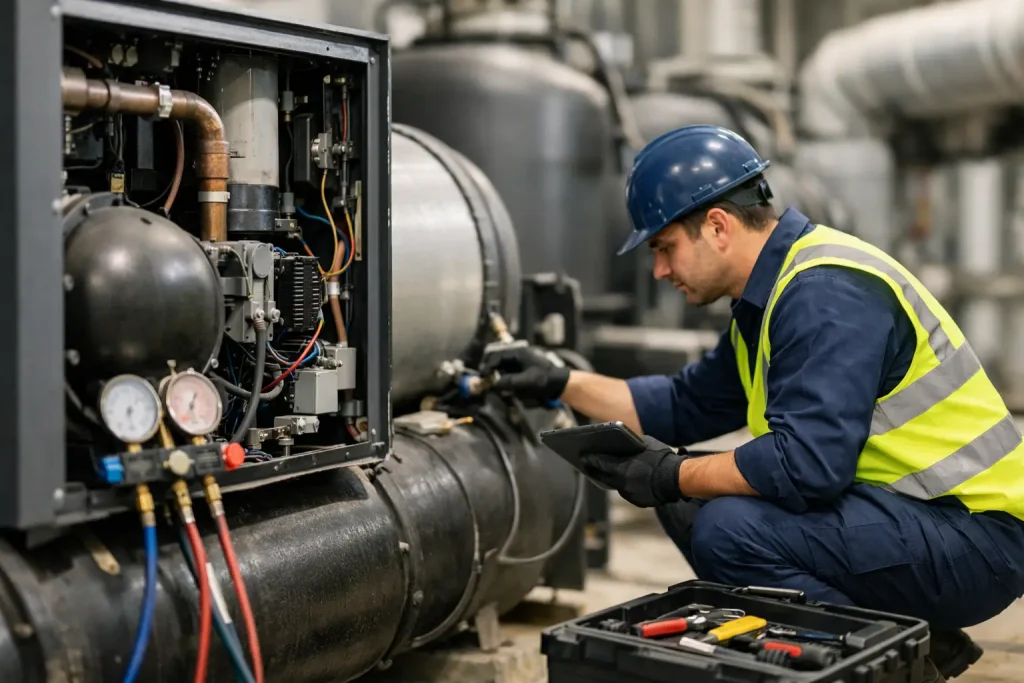
When a chiller drops out, the pressure is immediate. Server rooms heat up, retail stock is put at risk, guests start complaining, production slows, and building managers are suddenly fielding calls from every direction. In that moment, the emergency chiller repair process matters because a fast arrival on its own is not enough – the real value is in diagnosing the fault properly, stabilising the system safely, and restoring cooling with as little disruption as possible.
For most sites, an emergency callout is not just about getting a unit back on. It is about protecting business continuity, avoiding repeat breakdowns, and making sensible decisions under time pressure. That is why experienced engineers follow a clear process rather than guessing, swapping parts at random, or forcing a restart before the cause is understood.
What the emergency chiller repair process looks like on site
A proper response starts before tools come out of the van. The first step is gathering the right information from the site contact. Engineers need to know the type of chiller, the age of the plant, what alarms are showing, whether the failure was sudden or repeated, and what areas of the building are affected. If there is a history of nuisance trips, poor water flow, refrigerant loss, or electrical issues, that shapes the first checks.
On arrival, the priority is safety and system condition. A failed chiller can present more than one problem at once. There may be high pressure lockouts, low temperature faults, compressor issues, control failures, poor condenser performance, water treatment concerns, or electrical damage. If the unit has been short cycling or tripping repeatedly, forcing another reset without inspection can make a bad situation worse.
The engineer will normally confirm isolation where needed, inspect the plant visually, and check whether any obvious issues are present such as oil staining, burnt components, failed contactors, blocked strainers, failed pumps, fan faults, tripped breakers, frozen evaporators, or signs of leaks. This early stage often reveals whether the issue is mechanical, electrical, refrigeration-based, controls-related, or a combination.
First response: contain the risk and protect cooling
In an emergency, restoring full capacity is not always the first move. Sometimes the sensible decision is to protect the site while a fault is assessed. That may mean isolating a damaged circuit, running a secondary circuit if the machine allows it, checking whether standby equipment can be brought online, or adjusting the building management settings to reduce load on the affected plant.
That point matters on larger commercial systems. A chiller may serve multiple zones, process loads, or tenant spaces with different priorities. If a restaurant cold room, medical area, data space, or densely occupied trading floor is involved, response has to reflect that. The fastest repair is not always the best repair if it leaves critical areas exposed an hour later.
For smaller systems, the focus is often on whether the unit can be restarted safely after a control issue, sensor fault, flow problem, or temporary pressure imbalance. But even then, a restart should only happen after the operating conditions are checked. Quick wins are useful, but only when they are technically sound.
Fault finding under pressure
The core of the emergency chiller repair process is disciplined diagnosis. Good engineers do not treat every alarm as the fault itself. A high pressure trip, for example, may be caused by dirty coils, failed condenser fans, closed valves, poor water flow, overcharge, non-condensables, a control issue, or extreme ambient conditions. The alarm is the symptom. The job is to find the reason.
That means testing rather than assuming. Electrical checks may include incoming supply, phase condition, fuses, contactors, relays, overloads, compressor windings, and control voltage. Refrigeration checks may involve suction and discharge pressures, superheat, subcooling, refrigerant condition, leak indicators, oil level, and operating temperatures. On hydronic systems, water flow, pump operation, differential pressure, strainer condition, water temperature, and valve position all matter.
Controls are another common factor. Chillers increasingly depend on sensors, boards, inverters, BMS integration, and staged control logic. A failed transducer, bad connection, corrupted parameter, or communication fault can shut down an otherwise healthy refrigeration circuit. Equally, what appears to be a chiller fault can begin elsewhere in the system – for example, a pump failure, cooling tower issue, or external enable signal problem.
Temporary repair or full repair?
This is where experience really counts. In an emergency, there are times when a temporary repair is the right call. If a failed component can be bypassed safely to restore partial operation, or a damaged part can be replaced with stock carried by the engineer, that may get the site through a busy trading period or overnight critical load. The key word is safely.
A temporary repair should never be sold as a finished solution if it is not one. If a unit is restarted with one circuit isolated, a manual setting adjusted, or a workaround in place, the customer needs a clear explanation of what is running, what is not, and what follow-up work is still required. That protects the client and avoids the false impression that the problem has gone away.
Full repair on first attendance is possible in many cases, especially where the fault is a standard electrical component, sensor, flow switch, contactor, capacitor, fan motor issue, or straightforward control fault. But if the problem involves a major compressor failure, significant refrigerant leak, plate heat exchanger issue, contaminated system, or obsolete parts, the right next step may be stabilisation, temporary cooling strategy, and a clear plan for return works.
Why downtime often starts before the breakdown
Many emergency callouts are triggered by a sudden failure, but the warning signs were there earlier. Poor heat rejection, rising energy use, intermittent alarms, dirty condensers, untreated water circuits, drifting sensors, low refrigerant charge, and irregular servicing all increase the chance of an out-of-hours stop.
That does not mean every breakdown is preventable. Parts fail, weather changes, site loads shift, and older equipment reaches a point where reliability drops away quickly. Still, the difference between a controlled repair and a business-critical failure is often maintenance discipline. A chiller that is inspected properly is far easier to repair in an emergency because the engineer has history, baseline readings, service records, and a clearer view of what has changed.
Communication during an emergency chiller repair process
Customers under pressure do not just need technical work. They need straight answers. A good emergency response includes clear updates on what has failed, what is being tested, whether cooling can be restored today, and what risks remain if the system is run in a reduced state.
For facilities managers and site teams, that clarity helps with operational decisions. They may need to protect stock, move occupants, reduce internal heat loads, or coordinate with other contractors. Vague language wastes time. Practical language helps people act.
This is also why local, service-led engineering support matters. Response time is important, but so is having engineers who can take ownership of the problem rather than simply identifying a fault and walking away. AA Frost works in that hands-on way – stabilise the site, identify the cause, repair what can be repaired there and then, and give the customer a clear route to full reliability.
After the restart: the checks that matter
Once the chiller is back online, the job is not finished at the moment the alarm clears. Post-repair monitoring is essential. Engineers should confirm stable pressures and temperatures, verify amp draw, check flow conditions, review controls operation, and make sure the machine can cycle and stage correctly under load.
That follow-up matters because some faults only appear solved on the first restart. A contactor may pull in but overheat later. A pressure issue may return when ambient rises. A flow problem may only show itself when more of the building load comes back. Watching the plant properly after repair reduces the chance of a second failure an hour after the van leaves site.
It is also the point where broader recommendations should be made. If the fault was caused by poor water quality, blocked condensers, ageing controls, failing insulation, or neglected maintenance, the customer should be told plainly. Not as a sales push, but as practical advice based on what the system is doing.
When replacement becomes part of the conversation
Not every emergency repair should lead straight to replacement. If the unit is sound overall and the failure is isolated, repair is usually the sensible option. But there are times when continuing to patch an old chiller becomes more expensive and disruptive than planning a controlled upgrade.
That tends to happen when breakdowns become frequent, critical parts are no longer readily available, efficiency has dropped badly, or the plant no longer matches the building load. In those cases, an emergency visit can become the point where a customer decides to move from reactive spending to a more reliable long-term solution.
The right engineering partner will be honest about that trade-off. Sometimes the best emergency repair is the one that buys enough time to plan replacement properly rather than forcing a rushed decision at midnight.
If your site depends on chilled water or comfort cooling, speed matters – but method matters more. A calm, structured emergency response is what turns a breakdown from a crisis into a manageable repair, and that is what keeps people, products, and buildings protected when the system matters most.