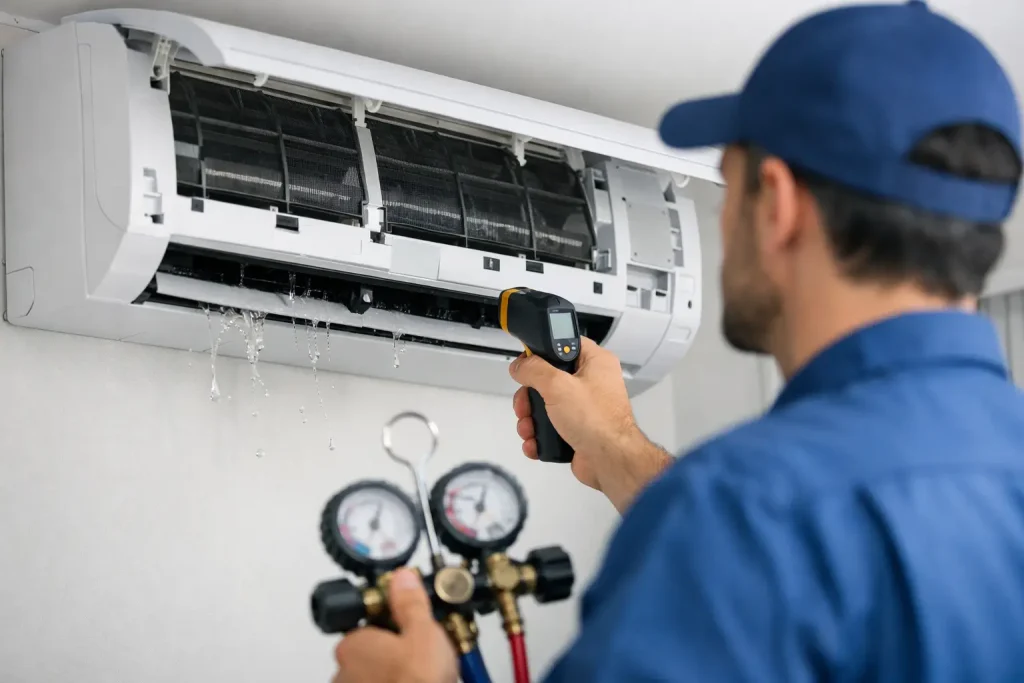
When the air conditioning stops in the middle of a busy service, a hot office afternoon, or a warm night at home, you need answers quickly. These aircon breakdown troubleshooting steps are designed to help you work through the obvious checks first, reduce unnecessary downtime, and spot when the fault needs an engineer rather than guesswork.
Aircon breakdown troubleshooting steps that should come first
Start with the basics, because many breakdown callouts turn out to be linked to power supply, settings, or restricted airflow rather than major component failure. That is good news if you catch it early, but it also means rushing straight to worst-case assumptions can waste time.
Begin by checking whether the unit has power at all. Look at the local isolator, fused spur, consumer unit, or distribution board, depending on the system type and whether you are dealing with a home split unit or a larger commercial installation. If a circuit breaker has tripped once, note it. If it trips again immediately after reset, stop there. Repeated tripping usually points to an electrical fault, compressor issue, fan motor problem, or wiring defect that needs professional attention.
Next, check the controller. It sounds simple, but incorrect mode selection, flat batteries in a remote, altered schedules, or temperature set points changed through a building management system can all make a working system appear failed. Cooling mode should be confirmed, the target temperature should be set below room temperature, and any timer or setback schedule should be reviewed. In commercial sites, this step matters even more because local controls and central controls do not always agree.
Then move on to airflow. Dirty filters, blocked return grilles, shut dampers, obstructed condensers, and furniture or stock placed too close to indoor units can all reduce performance sharply. Sometimes the unit is still running, but poor airflow makes it feel like a breakdown. If filters are visibly dirty, clean or replace them if that task falls within your normal maintenance routine.
What to check when the unit runs but does not cool
A system that powers on but fails to cool properly is one of the most common service issues. The fault may still be minor, but this is where the difference between a quick fix and a more technical repair starts to matter.
Check whether the indoor fan is operating normally and whether the outdoor unit is actually running. If the indoor unit blows air but the condenser outside is silent, the issue may sit with controls, power supply to the outdoor section, a failed capacitor, contactor problems, or compressor protection. If both sections run but cooling is weak, you may be dealing with dirty coils, low refrigerant charge, sensor faults, or airflow imbalance.
Look for signs of icing. Ice on pipework, evaporator coils, or the front of the indoor unit usually points to restricted airflow or refrigerant-related problems. A blocked filter can cause this, but so can a fan fault or low refrigerant. Turning the system off to let it thaw may prevent further strain, yet restarting it without fixing the cause often leads to the same problem returning.
Pay attention to how the system behaves over time. If cooling starts normally and then drops away, overheating, frozen coils, or intermittent controls may be involved. If temperatures never improve at all, the system could be undersized for the load, especially in kitchens, server rooms, glazed offices, or spaces where occupancy has changed. Not every cooling complaint is a breakdown in the strict sense. Sometimes the system is operational but no longer suited to the environment.
If water is leaking, act quickly
Water around an air conditioning unit should never be ignored. In a home, it risks damage to walls, ceilings, or flooring. In a commercial setting, it can disrupt trading, affect electrics, and create a slip hazard.
The first check is the condensate drain. Blocked drain lines are a frequent cause of leaks, particularly where routine maintenance has been missed. Algae, dirt, and debris can build up over time, stopping normal drainage. A drain pump failure can create the same result, especially on cassette or ducted systems where gravity drainage is limited.
If the leak is heavy, switch the system off and isolate the area if needed. Continuing to run the unit can worsen overflow and increase the risk of internal damage. In some cases, icing that later melts will also show up as leaking, so a water issue can be linked to airflow or refrigerant faults rather than drainage alone.
Strange noises and smells are useful fault clues
Unusual sounds often tell you more than a fault light does. A rattling panel may be minor. A buzzing contactor, grinding fan motor, or hard-starting compressor is not. The key point is whether the noise is new, persistent, and tied to a loss of performance.
A musty smell can indicate microbial build-up on coils or in drains. That is unpleasant, but often manageable through proper cleaning and maintenance. A burning smell is different. If you notice anything electrical, shut the system down and do not continue resetting it. Electrical odours can point to overheated wiring, motor failure, or damaged components.
Commercial operators should also think about timing. If a unit becomes noisy only during peak load, you may be seeing an early sign of a motor, bearing, or compressor issue that has not yet become a complete failure. Catching that early can be the difference between a planned repair and an out-of-hours breakdown.
Aircon breakdown troubleshooting steps for commercial sites
Commercial systems need a slightly different approach because the cause may sit beyond the indoor unit itself. On larger installations, fault tracing can involve controls strategy, phase supply, interlocks, pumps, valves, BMS commands, fresh air volumes, and multiple connected systems.
If a VRF, AHU, chiller-fed system, or multi-split arrangement is underperforming, check whether the problem is isolated to one zone or affecting the whole building. One failed indoor unit suggests a local issue. Several areas losing cooling at once may point to central controls, outdoor plant, refrigerant circuit problems, or power-related faults.
Review alarm codes if the system provides them, but do not treat them as a full diagnosis. Codes are useful starting points, not final answers. A high-pressure alarm, for example, could relate to dirty coils, failed condenser fans, restricted airflow, overcharge, or ambient conditions. The code tells you where to look, not always what part to replace.
Facilities managers should also consider business continuity while troubleshooting. If a comfort-cooling unit fails in an office, there may be short-term workarounds. If cooling fails in a comms room, restaurant, retail space, or occupied clinical environment, response time matters far more. In those cases, speed is part of the repair strategy.
When to stop troubleshooting and call an engineer
Some faults are safe to check. Others are not. If there is repeated electrical tripping, burning smell, refrigerant suspicion, compressor short cycling, failed motors, major water ingress, or no restoration after the basic checks, it is time to stop.
Air conditioning systems combine electrics, pressurised refrigerant, controls, and moving components. Trying to push beyond sensible first checks can increase damage, void warranties, or create a safety risk. For commercial systems, delay can also mean product loss, unhappy tenants, uncomfortable staff, or interrupted service.
This is where experienced fault diagnosis saves money. A proper engineer does not just swap parts and hope for the best. They test the system, confirm the cause, check associated components, and look at whether poor maintenance, ageing equipment, or load changes contributed to the failure. That matters because a repaired unit that breaks down again next week has not really been fixed.
Preventing the next breakdown
The best troubleshooting is the kind you rarely need because the system is maintained properly. Planned maintenance keeps filters, coils, drains, electrical connections, fan assemblies, and operating pressures under regular review. It also helps spot declining performance before it turns into a no-cooling emergency.
For homeowners, that may mean regular servicing and keeping filters clean. For businesses, it usually means a more structured maintenance schedule tied to the system type, occupancy, and operational risk. A small office and a high-demand hospitality site should not be maintained in the same way because the consequences of failure are completely different.
At AA Frost, we see this difference every day. Some breakdowns are genuinely sudden. Many others start as warning signs that were easy to miss during busy operations.
If your air conditioning is down, start with sensible checks, stay safe, and do not ignore signs that point to a deeper fault. The quicker the right issue is identified, the quicker comfort, cooling, and normal operations can be restored.