A hot upstairs bedroom at midnight usually settles the question faster than any brochure ever will. Home air conditioning installation is no longer a luxury for a handful of properties – for many households, it is a practical upgrade that improves sleep, home working, and day-to-day comfort when warm weather lingers.
The part that matters is getting it right first time. A well-installed system should cool efficiently, run quietly, and suit the way you actually use your home. A rushed or poorly planned job can leave you with uneven temperatures, higher running costs, and a unit that never quite delivers what you expected.
What good home air conditioning installation should achieve
The best installations are not just about adding cold air. They are about control, reliability, and making each room usable when outside temperatures rise. In many homes, the goal is steady comfort in bedrooms, loft conversions, garden rooms, and living spaces that trap heat through the afternoon and evening.
A good system should cool the room without short cycling, excessive noise, or a draught blowing straight onto the bed or sofa. It should also be sized properly. That point gets missed more often than it should. If a unit is too small, it struggles and runs harder for longer. If it is too large, it can cool the space too quickly without removing humidity effectively, which can leave the room feeling clammy rather than comfortable.
This is why installation matters as much as equipment choice. Even a strong brand and a high-spec unit can underperform if the pipe run, condensate drainage, controls, or unit position are poorly thought through.
Choosing the right system for your home
Most residential installations fall into one of two categories. A single split system suits one main room, such as a bedroom, lounge, or home office. A multi-split system connects several indoor units to one outdoor unit, which can be useful when more than one room needs cooling but external space is limited.
The right answer depends on your property layout, how many rooms you want to cool, and whether you plan to use the system for heating in colder months as well. Many modern air conditioning systems are heat pumps, so they can provide efficient heating as well as cooling. For some homeowners, that added flexibility changes the value of the installation completely.
There are trade-offs. A single split is often simpler and more cost-effective if one room is the main problem area. A multi-split can give broader coverage and a neater external appearance, but installation is more complex and system design becomes more important. In larger homes, or where several zones need independent control, a more advanced setup may make sense.
What matters most is not choosing the biggest system or the one with the longest feature list. It is choosing one that suits the property and the people using it.
What an installer should assess before fitting anything
A proper site survey is where a reliable installation starts. That survey should look at room size, ceiling height, insulation levels, glazing, sun exposure, and heat generated by people or equipment in the room. A south-facing loft room with large windows behaves very differently from a shaded ground-floor lounge.
The installer should also assess practical issues such as outdoor unit placement, pipe routes, power supply, drainage, and where the indoor unit can be positioned for the best airflow. This is not just a technical detail. A unit placed in the wrong spot can create noise issues, poor circulation, or an awkward appearance that homeowners regret as soon as the job is finished.
If you are renovating, extending, or upgrading several services at once, this planning stage becomes even more valuable. Coordinating the air conditioning installation with electrical work or decorating can reduce disruption and avoid remedial costs later.
Home air conditioning installation step by step
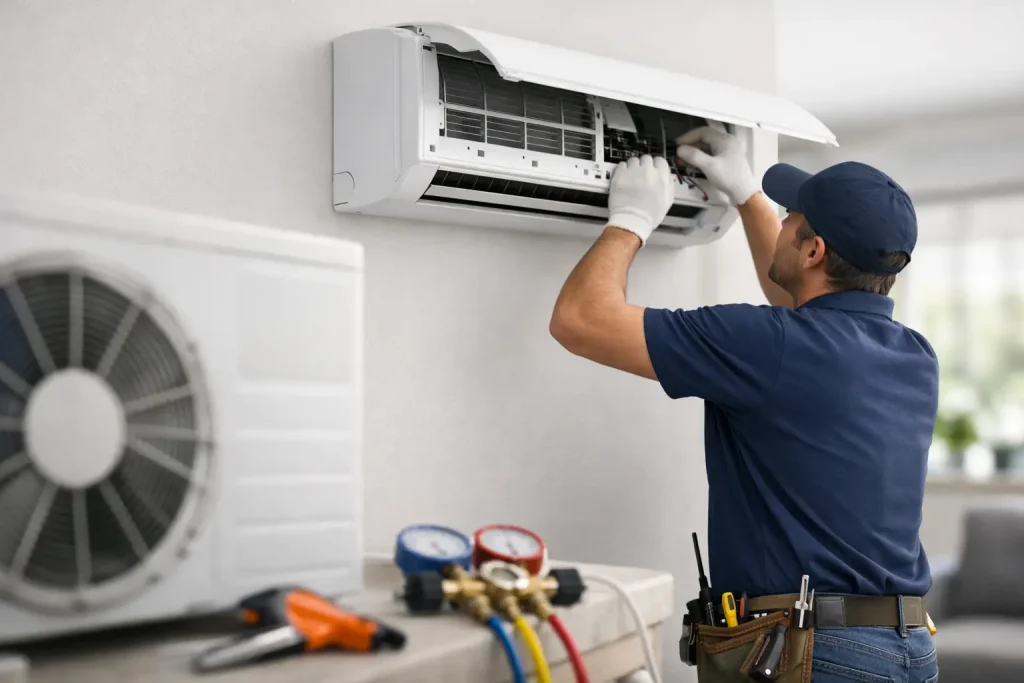
Once the system design is agreed, the installation itself is usually straightforward in the hands of an experienced engineer. The indoor unit is mounted in the chosen room, and the outdoor condenser is fixed in a suitable external location. Refrigerant pipework, power connections, and condensate drainage are then run between the units.
After that, the system is pressure tested, evacuated, and commissioned. This is the stage where performance is checked, controls are set up, and the installer confirms the system is operating safely and efficiently. Homeowners should also be shown how to use the controller properly, including temperature settings, modes, timers, and filter care.
The exact timescale depends on the property and the number of rooms involved. A single-room installation can often be completed in a day. Multi-room systems or more complex routing can take longer. Access, wall construction, outdoor mounting requirements, and electrical upgrades can all affect the programme.
That is normal. What you want is not speed at any cost, but a clean, well-managed installation that avoids corners being cut.
Common mistakes that cause problems later
The most expensive issues are often preventable. Poor sizing is one. Bad unit positioning is another. Some homeowners focus so heavily on hiding the unit that airflow and service access are compromised. Others choose solely on upfront cost, only to find the system is louder, less efficient, or less reliable than expected.
Drainage is another area where proper installation matters. If condensate is not managed correctly, leaks and water damage can follow. Pipework quality, insulation, and commissioning standards also make a real difference to long-term performance.
Then there is aftercare. Even the best-installed system benefits from periodic maintenance. Filters need attention, coils need checking, and overall performance should be monitored. If a system is expected to run regularly through summer and into winter heating mode, neglect will catch up with it sooner rather than later.
Running costs and energy efficiency
Most homeowners ask the same question after installation cost – what will it cost to run?
The honest answer is that it depends on the unit efficiency, room conditions, thermostat settings, and how often the system is used. A quality inverter system that is correctly sized and professionally installed will generally run far more efficiently than older or poorly matched equipment. Keeping doors and windows closed, using sensible temperature settings, and maintaining filters also helps.
There is a practical balance here. Setting a room to extreme temperatures does not make the system work smarter. It usually just makes it work harder. In most homes, a moderate set point provides good comfort without unnecessary energy use.
Energy-efficient systems can also offer better value over time, even if the initial outlay is higher. For homeowners planning to stay in the property, that longer view is often the right one.
How to choose an installer with confidence
When you are comparing quotes, look beyond the headline figure. You want a company that treats installation as an engineered service, not a quick fit job. That means a proper survey, clear recommendations, attention to electrical and drainage requirements, and commissioning carried out to the right standard.
It also helps to choose an installer with broader technical experience. A company that works across residential and commercial cooling systems usually brings a stronger understanding of performance, fault prevention, and system reliability. That depth matters, especially when you want something that works well in year one and still performs properly years later.
Responsiveness matters too. If support is needed after the installation, you want to know there is a real service team behind the work. That is one reason many homeowners prefer established engineering companies rather than one-man operations fitting systems as a sideline.
For households that want dependable advice and practical support, AA Frost approaches residential air conditioning the same way it handles critical cooling environments – with clear planning, experienced engineers, and a focus on getting the system right first time.
Is home air conditioning installation worth it?
For many homes, yes – but the value depends on why you are doing it. If one bedroom overheats for a few nights a year, a permanent system may not be the first answer. If several rooms are uncomfortable for long periods, sleep is affected, and working from home becomes difficult through warmer months, installation starts to look less like a luxury and more like a sensible upgrade.
There is also the year-round benefit to consider. Systems with heating capability can support comfort outside summer, particularly in rooms that are expensive or awkward to heat with the main system. That makes the investment easier to justify in practical terms.
The key is to treat it as a property system, not an impulse purchase. Good design, careful fitting, and reliable aftercare make all the difference.
If you are considering home air conditioning installation, the best next step is a proper assessment of the rooms that cause the most trouble. Once you know what the space actually needs, the right solution becomes much clearer – and the result is a home that stays comfortable when you need it most.