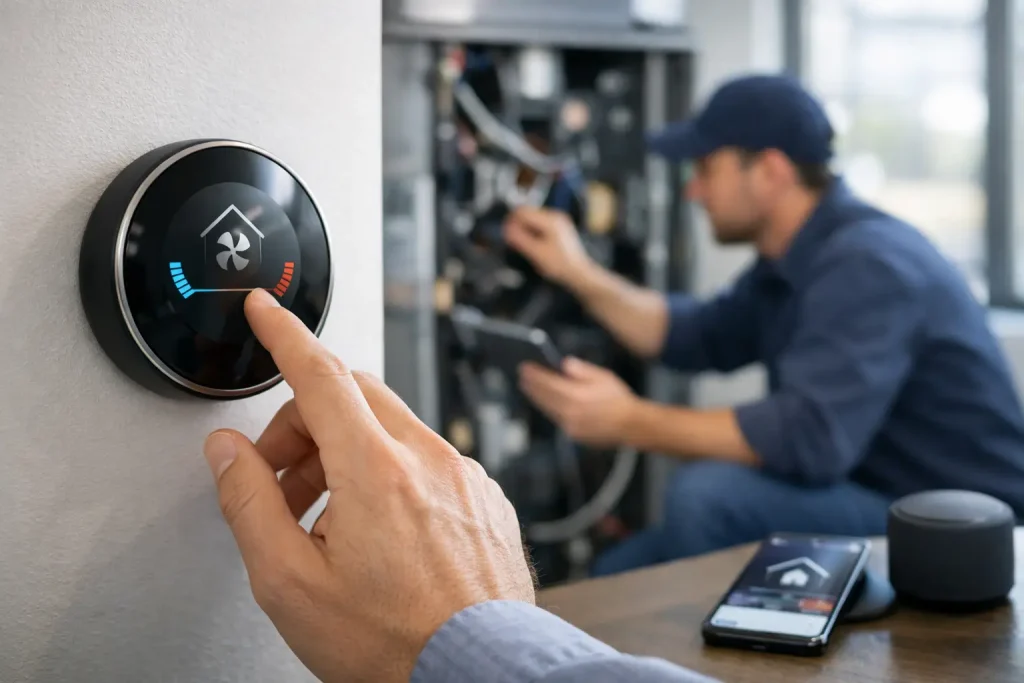
If your heating and cooling plant still runs on fixed time schedules, manual overrides and repeated callouts to correct the same comfort complaints, a smart HVAC controls upgrade is not a luxury. It is often the quickest way to regain control of energy use, room conditions and maintenance issues without replacing every major piece of equipment.
For facilities managers, restaurant operators, landlords and homeowners, the problem is rarely just the boiler, condensing unit or air conditioning unit on its own. It is usually how the whole system behaves across the day. Fans run when the building is empty. Setpoints get changed and never reset. One area is freezing while another is too warm. Equipment short cycles, works harder than it should and fails sooner than expected. Controls are where those problems either get corrected or allowed to continue.
What a smart HVAC controls upgrade actually changes
A proper upgrade does more than swap an old thermostat for a newer screen. It changes how your system responds to occupancy, outside temperature, internal load and operating hours. In a commercial building, that might mean linking air conditioning, ventilation, heating and alarms into one clear control strategy. In a home, it could mean zoning, smarter scheduling and remote access that actually reflects how people live.
The main benefit is not the technology itself. It is the ability to stop waste and catch issues early. Good controls can reduce unnecessary run time, hold more stable temperatures and flag faults before they become a full breakdown. For businesses with critical cooling or customer-facing spaces, that matters just as much as the energy saving.
There is also a practical maintenance advantage. When engineers can see trend data, alarm history and operating patterns, faults become easier to diagnose properly. That means less guesswork, fewer repeat visits and less downtime.
Where older control systems usually fall short
Many sites still rely on controls that were acceptable when installed but are now too limited for the way the building is used. Time clocks drift. Sensors fall out of calibration. Interfaces are awkward, so staff apply manual overrides instead of fixing the schedule. In some cases, bits have been added over the years until no one is fully sure what controls what.
That is common in restaurants, offices, retail units and mixed-use properties. A site may have had an extension, a layout change or different occupancy patterns since the original system was set up. The HVAC plant keeps running, but not efficiently. Complaints rise, energy bills creep up and the equipment gets blamed for what is really a controls problem.
The same applies in homes, especially where there are multiple indoor units, underfloor heating zones or a newer air conditioning system connected to old room controls. The hardware may be capable of much better performance than the controls allow.
Signs your site is ready for a smart HVAC controls upgrade
If the same areas regularly overheat or overcool, if energy use feels out of proportion to occupancy, or if staff keep changing settings to get through the day, the controls deserve attention. Frequent short cycling, poor coordination between ventilation and cooling, and systems running out of hours are other clear warning signs.
You do not always need a major plant replacement to solve these issues. Quite often, better control logic and modern monitoring provide a noticeable improvement on the existing system.
The strongest business case is usually operational, not just financial
Energy savings are the headline, and rightly so. Smarter scheduling, demand control and tighter temperature management can reduce waste. But on many sites, the real return comes from smoother operation.
A restaurant cannot afford an uncomfortably warm dining area during service. An office cannot keep fielding complaints from different floors because temperatures swing all afternoon. A managed property cannot keep sending contractors back to reset equipment that should be self-managing. Better controls reduce those avoidable disruptions.
There is also an asset protection angle. HVAC and refrigeration equipment tends to last longer when it is not constantly fighting poor setpoints, bad sequencing or unnecessary run hours. That does not mean controls remove every failure risk. Compressors, valves, sensors and fans still wear out. But they can help the system operate within sensible limits and reveal deterioration earlier.
What to expect from a well-planned smart HVAC controls upgrade
The first step should be understanding how the site actually operates, not just what equipment is installed. That means looking at occupancy patterns, critical rooms, existing complaints, current controls, alarm history and known fault trends. An upgrade only works if the control strategy reflects the building in real use.
On a commercial site, this may include BMS integration, zoning adjustments, occupancy scheduling, remote monitoring, temperature averaging, staged operation and alarm notifications. For larger systems such as VRF, AHUs, chillers and cooling towers, control coordination is especially important. If one part of the system responds too early or too late, the rest of the plant ends up compensating.
For a home, the focus is usually simpler but still valuable. Better room-by-room control, mobile access, weather-responsive scheduling and clearer user settings can improve comfort while reducing waste. The key is making the system easier to manage, not more complicated.
Smart HVAC controls upgrade and BMS integration
If your building already has a BMS, the question is not whether you need another separate platform. It is whether the controls can be upgraded in a way that improves visibility and decision-making without creating more layers to manage. In some buildings, integration is the best route because it gives one view of heating, cooling, ventilation and alarms. In others, especially smaller properties, a simpler standalone control setup may be more practical.
This is where experience matters. Not every site needs the most advanced specification. The right answer depends on plant type, budget, staffing and how critical environmental control is to the operation.
The trade-offs to think about before you proceed
A smart controls project should not be sold as a magic fix. There are trade-offs. Upfront cost is the obvious one, especially if the existing wiring, sensors or panels are in poor condition. Some upgrades uncover other issues, such as failing actuators, stuck dampers or plant that has been operating around hidden faults for years.
There is also the handover question. If the interface is too complex, site staff may avoid using it properly or create new problems with ad hoc changes. Simpler, well-labelled controls often outperform over-engineered systems because they are actually used correctly.
Cybersecurity and remote access need thought too, particularly on commercial premises. Remote visibility is useful, but it should be configured securely and with the right access levels. Convenience should not come at the expense of control.
Choosing the right scope for the site
Not every upgrade has to be a full overhaul. In some cases, replacing obsolete controllers, recalibrating sensors and correcting schedules will deliver a strong result. In others, the system needs a wider redesign because the current logic no longer matches the building.
That is why a site survey matters. A dependable engineer will look at what can be retained, what needs replacing and where the real value sits. Spending carefully on the controls layer can often delay more expensive plant replacement, but only if the underlying equipment is still fundamentally sound.
For businesses, disruption during works should also be part of the plan. The best projects are staged around trading hours or operational priorities so comfort and cooling are maintained wherever possible. Speed matters, but so does getting the logic right the first time.
Why aftercare matters as much as installation
Controls are not fit-and-forget. Once installed, they need checking, fine-tuning and occasional adjustment as occupancy changes or seasons shift. Trend data may show that a setpoint needs refining or a schedule could be tighter. That is normal. Good commissioning and follow-up support are what turn a controls upgrade from a clever idea into a lasting improvement.
For that reason, many property owners and site managers get better long-term value when the same engineering partner handles installation, fault finding and planned maintenance. Problems are resolved faster when the team already understands the site and can see the controls in context. For businesses that cannot tolerate downtime, that continuity is worth a great deal.
A smart HVAC controls upgrade makes most sense when you want more than a newer wall controller. It is about making the system respond properly to the building, reducing waste, cutting repeat faults and giving you clearer control over comfort and performance. If your current setup feels reactive, inconsistent or expensive to run, the controls may be the smartest place to start.